By Outdoor Next Editorial standards
On this page
Key facts
- Dates and route
- Controlled by the written offer; do not assume an extension.
- Compare costs
- Hire, fuel, ferry, cover, kilometres, charges, overnights and connecting travel.
- Funds available
- Keep the bond/card hold separate from expected trip spending.
- Availability
- Operator pages checked 29 October 2026; no live booking confirmed.
Checked against official sources on 29 October 2026. Confirm with the official source before you go.
A campervan relocation can save on hire when you can move the vehicle on the operator's terms. Start with the written deadline and total cost, then decide whether the remaining time supports the trip you want. It is a vehicle transfer as well as a holiday.
Sources checked 29 October 2026. This is a guide to comparing offers, not a list of vehicles available now. Check current prices and availability with the operator before arranging flights or non-refundable stays.
What a relocation actually gives you
Travellers Autobarn's NZ conditions require pickup and return at agreed locations and dates, retain standard rental terms, allow possible kilometre restrictions and make extensions conditional. Spaceships distinguishes a constrained relocation from ordinary one-way hire. Neither comparison gives a universal allowance or extension right. Checked 29 October 2026.
The Spaceships page viewed today has a 23 October 2026 update advertising Christchurch-to-Auckland relocations. Its ferry inclusion is vehicle only, with driver/passenger charges separate. This supersedes the older season-ended wording in our previous review. It is a dated webpage observation, not confirmation that any slot remains available; read the current page and your own booking conditions.
Decide whether it suits your trip
These are editorial decision prompts. A relocation is worth considering only if the actual agreement works for your group and dates.
| Your situation | Compare before accepting |
|---|---|
| Already heading between the listed depots | Full cost against ordinary one-way hire on the same dates |
| Flexible route with no fixed activities | How much usable time remains after pickup, travel and handover |
| Family trip or slower travel pace | Whether the deadline leaves comfortable breaks and contingency |
| A must-do walk, kayaking booking or island crossing | Whether changes to that activity would jeopardise the vehicle return |
| Arrival after a long flight | Rest arrangements before driving, rather than a rushed first transfer |
| Fixed onward flight or work commitment | Consequences of a changed vehicle, road delay or cancelled ferry |
If the saving depends on skipping rest or assuming an extension, compare a shorter route or ordinary hire. Our trip directory is useful for ideas, but its itineraries are not guaranteed to fit a relocation's days or kilometre allowance.
Compare total costs and required funds
Use the same travellers, dates, start and end points for both options. Do not compare a relocation headline with a normal rental's complete quote. The questions below identify possible costs; they do not mean every provider charges each one.
| Item | Ask for a written answer |
|---|---|
| Hire and time | Included days, pickup/return times, extra days and late-return conditions |
| Kilometres | Included distance, excess-kilometre rate and permitted detours |
| Fuel | Pickup/return level, allowance cap, receipts and reimbursement process |
| Ferry | Who books, included vehicle space, passengers and change fees |
| Cover and liability | Included protection, excess, exclusions and available options |
| Bond/card hold | Amount, accepted card, available funds and release process |
| Other charges | Whether road user charges, cleaning, equipment or administration apply |
| Connecting travel | Flights, public transport, taxis and accommodation needed at each depot |
| Overnights | Lawful campsites or other stays for the actual route |
| Changed plans | Cancellation, substitution, disruption and missed-connection costs |
Working comparison: add confirmed hire, connecting travel, fuel, ferry, cover, applicable charges and overnights; subtract only allowances you qualify for and can claim. Build the ordinary-hire total in exactly the same way. Use the trip budget guide to check for missing categories.
Keep the bond or card hold separate from expected spending. Ask whether it affects your available credit for fuel, stays and other travel, and what the agreement says about liability beyond the hold. Do not treat an unclaimed reimbursement as money already available during the trip.
Build the route backwards from handover
Start with the actual depot address and agreed return time. This table is a scheduling aid, not an official drive-time estimate.
| Work backwards from | Leave room for |
|---|---|
| Depot return | Required refuel, cleaning, inspection and handover arrangements |
| Final overnight base | A manageable transfer and a fallback if the main route is disrupted |
| Ferry, if included | Terminal access, check-in, sailing and a disruption plan |
| Earlier transfers | Meals, breaks, supplies, weather and road changes |
| Pickup | Rest, paperwork, vehicle familiarisation and checking supplied equipment |
Tourism New Zealand's calculator provides approximate travel estimates, excluding stops and allowing for the possibility of longer journeys. It recommends breaks and extra time. Check NZTA Journey Planner for highway delays, roadworks and closures; consult the relevant council for local roads. Checked 29 October 2026.
Ask the rental company which roads and surfaces are permitted for the supplied vehicle, and how to notify it of delays. Do not assume the contract deadline changes automatically. Our driving guide and conditions links help organise the remaining checks.
Inter-island relocations: resolve the ferry first
Interislander's current guidance says rental companies differ: some let their vehicles cross, while others require a vehicle exchange. Confirm what your agreement permits before reserving a ferry. A vehicle-only inclusion is not the same as a ticket for everyone aboard.
Check these details together:
- Who makes and pays for the reservation, and whose confirmation you will receive.
- The actual vehicle type, height and full length, including attached equipment.
- Every driver's and passenger's ticket, plus any conditions attached to the allowance.
- The terminal, sailing and check-in instructions on your confirmation.
- The response to a cancellation: notification, rebooking, deadline and additional costs.
Interislander advises arrival at least 60 minutes before departure, for vehicles and foot passengers. Recheck your booking instructions and terminal arrangements; this is not a timing rule for all ferry operators. Checked 29 October 2026.
If the crossing is unresolved, keep connecting travel flexible. Use our Marlborough Sounds basecamp plan and Wellington destination guide for onward planning, without assuming those stops fit the relocation's deadline.
Check the actual vehicle and overnight arrangements
Before accepting, confirm the supplied sleeping layout, bedding, cooking equipment, restraints needed by your group, driver eligibility and the licence/rental requirements. These are questions for your specific booking; a vehicle-category name is not a complete inventory.
For places requiring self-contained certification, inspect the actual vehicle's status. PGDB's guidance states that only green-warrant certification is recognised as self-contained from 7 June 2026. Do not rely on an old blue sticker or the appearance of a campervan. Checked 29 October 2026.
Certification does not grant permission to stay everywhere. Read the freedom camping guidance and check the destination's current rules, or choose campgrounds that accept the vehicle. For example, the Momorangi Bay campground guide can help research a Picton-area stay; verify its current arrival arrangements and availability yourself.
Schedule water, waste and laundry, and leave room for cleaning outdoor gear between activities. The historical campervan photograph accompanying this guide is not an example of a currently available relocation or evidence of permission to camp in that location.
Before you accept
- Save the exact offer and complete rental conditions, including dates, depots and handover requirements.
- Compare the complete cost with normal hire; keep the bond/card hold separate.
- Confirm kilometres, allowances, extensions, cancellation and liability in writing.
- Resolve ferry permission, booking, passenger costs and disruption arrangements.
- Plan lawful overnight stays and a route with room for breaks and changed conditions.
- Confirm the actual vehicle, driver requirements and required equipment; adapt the packing list.
- Decide what you will do if the vehicle, road, ferry or activity changes before or during the hire.
Return to the planning hub, or compare our North Island and South Island frameworks with the time and distance your written offer actually allows.
More photographs
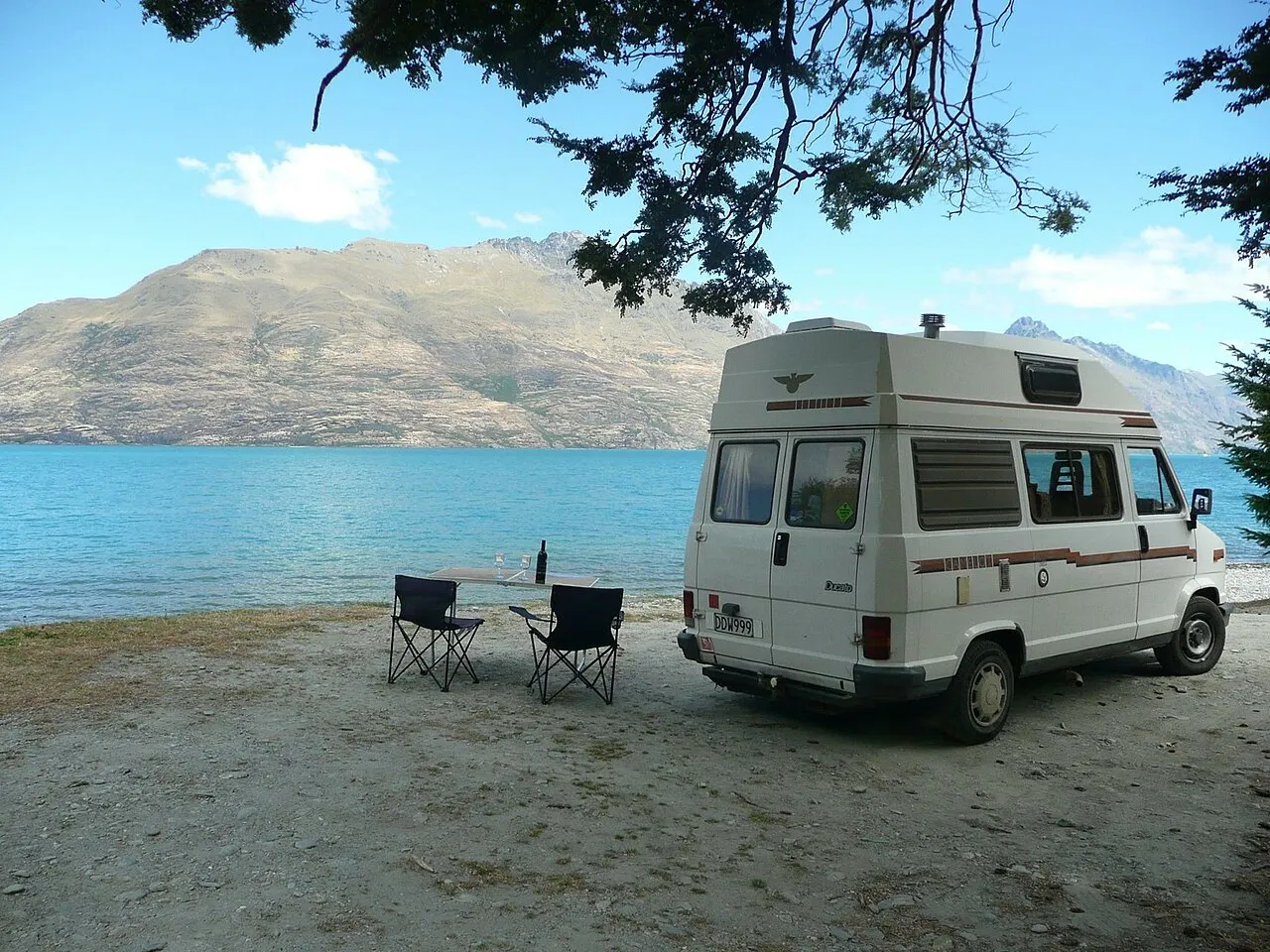
Illustrative photograph. A campervan beside Lake Wakatipu, photographed in September 2016. General vehicle-travel illustration only: the van is not a relocation offer, and the photograph is not evidence of camping permission, vehicle certification or present conditions. Photographed September 2016.
Photo: dorfor / CC0 1.0 / DetailsFrequently asked questions
Are campervan relocations always available?
No. Routes, vehicles and dates depend on fleet movements. Read the operator's current page and obtain confirmation of a specific offer before buying connecting travel; an advertised listing is not a reservation.
Does free or low-cost hire include fuel and ferry passengers?
Do not assume it does. Ask which costs are included, who books the crossing and how allowances are claimed. The Spaceships page checked on 29 October 2026 described a vehicle-only ferry inclusion for its advertised offer, with driver and passenger charges separate. Your written booking controls.
Can I extend the hire or change the route?
Only if the operator agrees under the conditions for your booking. Confirm extra days, kilometres, permitted roads and charges in writing before relying on a detour or extension.
Is a bond the same as the trip cost or maximum liability?
Do not assume so. Ask how the bond or card hold works, what funds must remain available, when they are released and what other charges or liabilities the agreement allows. Compare expected spending separately from the funds needed for the hold.
What happens if a ferry cancellation makes me late?
Check the relocation and ferry terms before accepting the offer. Ask who to notify, how the return deadline is handled and who pays additional costs. A disruption should not be assumed to extend the rental automatically.
Can I freedom camp in a relocation van?
Only where the actual vehicle and overnight location meet the applicable requirements. PGDB says only green-warrant certification is recognised as self-contained from 7 June 2026. Certification does not grant permission at every site; confirm local rules or reserve an appropriate campground.
Sources & official links
- 1.Campervan relocations and conditions— Travellers Autobarn New Zealand
- 2.Relocations compared with one-way hire— Spaceships Rentals New Zealand
- 3.Private vehicle owners: green-warrant certification— Plumbers, Gasfitters and Drainlayers Board
- 4.Interislander ferry FAQs— Interislander
- 5.Journey Planner: highway conditions and disruptions— NZ Transport Agency Waka Kotahi
- 6.Travel time and distance calculator— Tourism New Zealand