By Outdoor Next Editorial standards
On this page
Location & access
DOC track reference point, not a verified trailhead, entrance or the whole route. Check the official route directions before travel.
Official location informationLocation source
DOC track reference point, not a verified trailhead, entrance or the whole route.
Reference point: -43.88825, 172.97826. WGS84 coordinates retained at the official service's returned precision; decimal resolution is not survey accuracy. Source positional accuracy is not specified.
DOC Maps walking and tramping reference point (WGS84), exact official-page GUID / Department of Conservation. Checked 2026-10-12.
Key facts
- Distance
- 1 km return via same track
- Walking time
- 40 min return
- Track grade
- Easy
- Location
- Banks Peninsula area
- Dog access
- No dogs. Other pets on conservation land rules.
Checked against official sources on 8 October 2026. Rules and conditions are set by Department of Conservation — confirm with them before you go.
Route overview
Easily accessed from Akaroa with a 4WD, this short walk includes the relics of a rich history, dramatic views and stunning wildlife.
This DOC directory entry covers Akaroa Head Scenic Reserve walk in Canterbury, within Banks Peninsula area. Where DOC groups several walks, times and grades refer to the listed options rather than a single continuous itinerary.
Distance, time and grade
- Distance: 1 km return via same track
- Walking time: 40 min return
- DOC grade: Easy
Access and alerts
Source checked 2026-10-08. This page is a dated snapshot, not a live track-status report. Check current DOC route information immediately before travelling. An absence of listed alerts does not establish that a route is open.
Dog access
No dogs. Other pets on conservation land rules.
Description
Lighthouse Road is not suitable for campervans. The road is narrow with few opportunities to safely turn around. The road changes to gravel at Wright Lookout on the Akaroa side of the hill and can be slippery in wet or icy conditions. Only 4WD vehicles should proceed past this point.
Stop at the small carparking area on the left of Lighthouse Road, 4km from the top of the hill. Do not drive past this point.
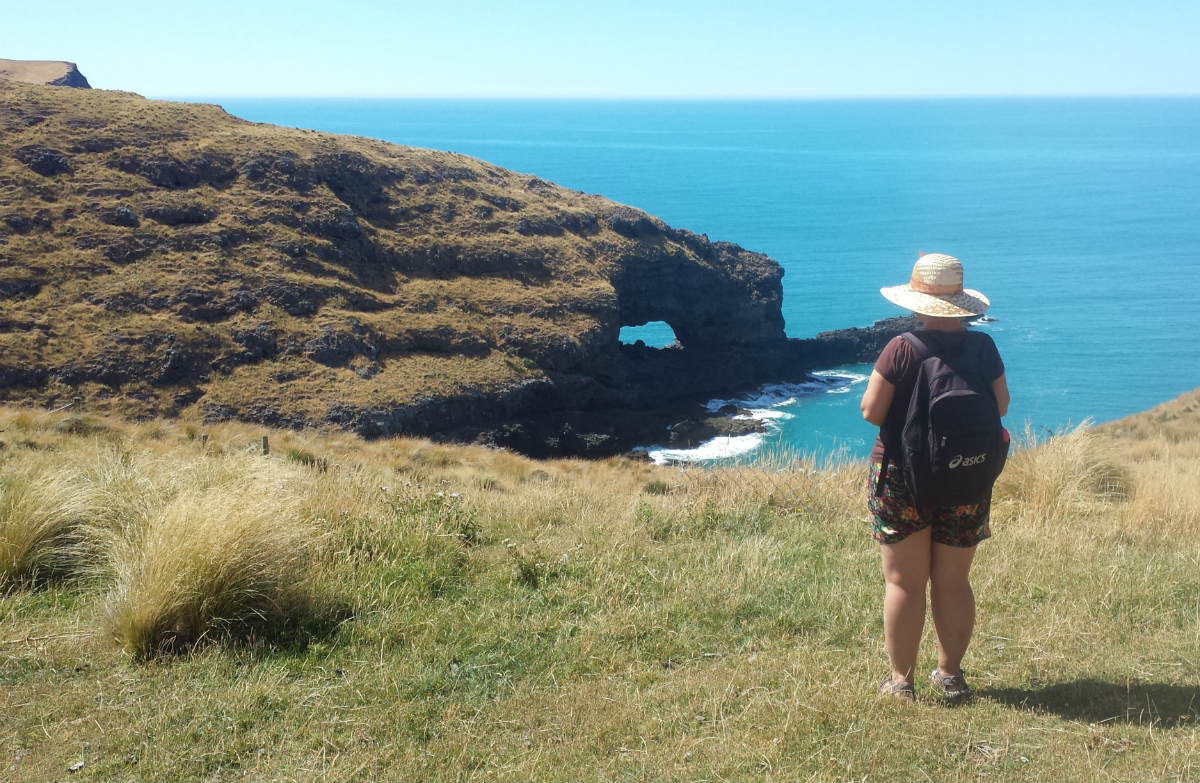
From the carpark follow the road down past the foundations of the lighthouse keeper’s house and other buildings, to the site of the old lighthouse. Here there are fantastic views of towering cliffs along the coastline and towards the mouth of the Akaroa Harbour.
From the lighthouse view point, follow the old supply road down. It then passes a horse water trough and an original stone culvert. The road ends at a vertical iron ladder descending to a rock shelf in Little Haylocks Bay. The bay is within the Akaroa Marine Reserve and is home to a variety of wildlife including fur seals/kekeno seals which haul out on the rock platforms, white-flippered penguins/kororā and a number of seabirds.
This reserve overlooks the Akaroa Marine Reserve in the Akaroa Harbour.
The headland is very exposed to the weather. Be prepared for extremes of heat, wind and cold. Precipitous cliffs, steep unfenced drops and access to deep water means that children should be closely supervised at all times. It is recommended that children do not descend the ladder.
Getting there
From Akaroa, take the Akaroa Lighthouse Road. This is 11 km of steep, narrow rough road, suitable for four wheel drive vehicles.
Know before you go
The headland is very exposed to the weather. Be prepared for extremes of heat, wind and cold.
Keep your children safe by closely supervising them at all times. This is because of the high cliffs, steep unfenced drops and access to deep water. We recommend not taking children down ladder.
View MetService tide timetable when planning your trip to Akaroa Heads. Tide timetables are for your safety.
Nature and conservation
Fur seals/kekeno are seen in the bay, with local colonies of white-fronted terns/tara, black-backed gulls/karoro and white-flippered penguins/kororā.
History and culture
The original Akaroa lighthouse was replaced in 1977 by an automated light, and in 1980 the lighthouse was relocated to Akaroa.
Sources and reuse
Route descriptions and practical information reproduced from the Department of Conservation, Crown copyright, under CC BY 4.0, subject to DOC's copyright policy. Formatting has been adapted, including flattening page sections; follow the original DOC page for maps, section-specific layout, current notices and linked documents. Outdoor Next is independent and is not endorsed by DOC.
The accompanying photograph is published in DOC's official route gallery with an explicit reuse licence. Its original caption and credit are retained; it does not establish current track conditions.